The Data Foundation Is Key for the AI Journey: north.io at Hydro 2026
Artificial intelligence is becoming a strategic capability for offshore and hydrographic organisations. But the main bottleneck is often not the model. It is the data behind it.
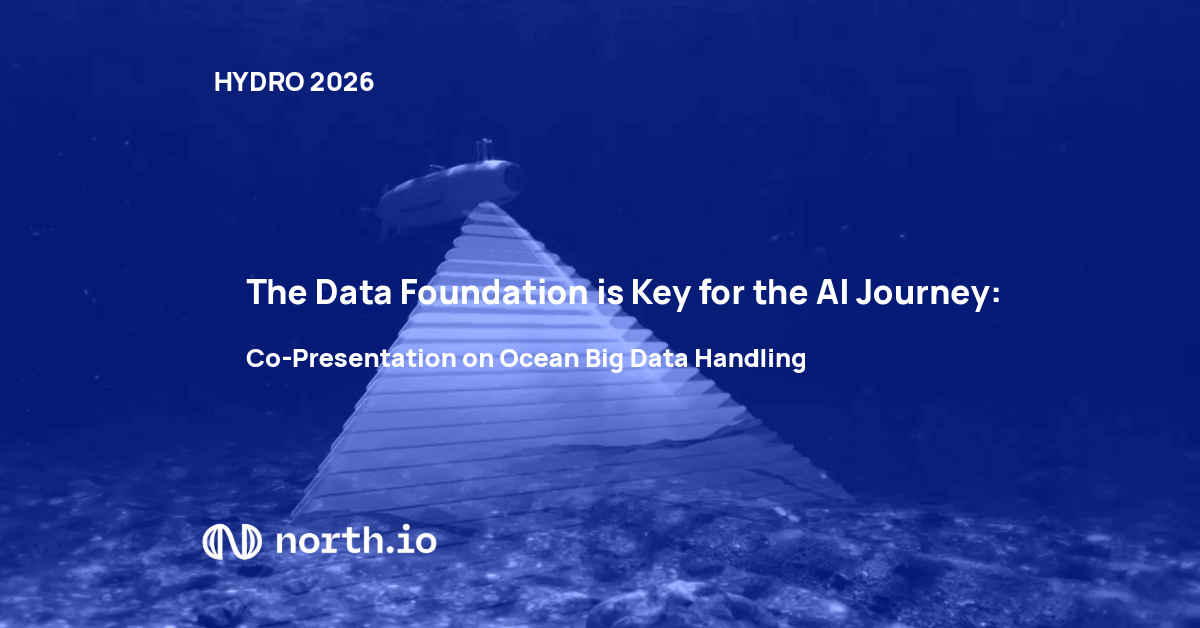
On 28 October 2026, north.io CEO Jann Wendt co-presented with Jan De Nul at Hydro 2026 in Antwerp. The talk, The Data Foundation is Key for the AI Journey: A north.io / Jan De Nul Co-Presentation on Ocean Big Data Handling, was part of Session 5: Object detection and AI.
What is Hydro 2026?
Hydro 2026 is the annual hydrographic conference. This year it is organised by the Hydrographic Society Benelux on behalf of the International Federation of Hydrographic Societies. It took place from 27 to 29 October 2026 at the Waagnatie, an industrial landmark on the River Scheldt in Antwerp. The programme covers topics such as unmanned and autonomous systems, data processing advances, and advanced sensor technologies. An exhibition runs alongside it.
Why does AI readiness start before AI?
Offshore survey data is large, project-specific, and spread across systems and formats. Typical sources include multibeam echosounder data, side scan sonar, sub-bottom profiler data, positioning information, logs, derived surfaces, mosaics, annotations, and GIS context layers.
To be useful for AI, this data must be:
- Findable, accessible, interoperable, and reusable
- Linked to metadata, quality information, and lineage
- Processed through transparent, reproducible workflows
Without that layer, AI stays in a collection of isolated scripts and proof-of-concept experiments.
Key takeaway
AI readiness starts before the AI itself. It starts with structured data, standardisation, traceability, and governed workflows.
The AI model, whether object detection, outlier filtering or an LLM assistant, is what everyone sees, which is 10% effort. The other 90% is the data foundation beneath the surface:
- Readable raw sensor data, with full raw format support
- Standardised products in one searchable catalogue
- Quality-controlled labels that are reviewed and versioned
- Lineage and governance, so data is traceable and access-controlled
- Scalable compute across petabytes, on CPU and GPU, anywhere
Without this foundation, every AI use case has to rebuild the iceberg. That is why so many AI pilots stay side projects: valuable in a demo, but rarely usable across the business.
Built to scale
north.io’s Ocean Data Platform is cloud-native by design. It combines a petabyte-scale distributed processing engine with automated QC and preprocessing pipelines. It runs in cloud, on-premise or air-gapped environments, and supports more than 180 data formats. As AI use grows, compute demand grows with it, and elastic infrastructure can follow where fixed infrastructure cannot.
The bottom line
The goal is to help organisations move from project-based data handling to repeatable, auditable, and scalable AI-enabled operations. Once the foundation is in place, new AI use cases plug in without rebuilding the environment. Feedback also flows back into the next training dataset, so the AI improves with every project.
If your organisation needs help with its AI readiness and is interested in learning more. Reach out today.