north.io and COE CSW Think tank Collaborate to Protect Critical Underwater Infrastructure
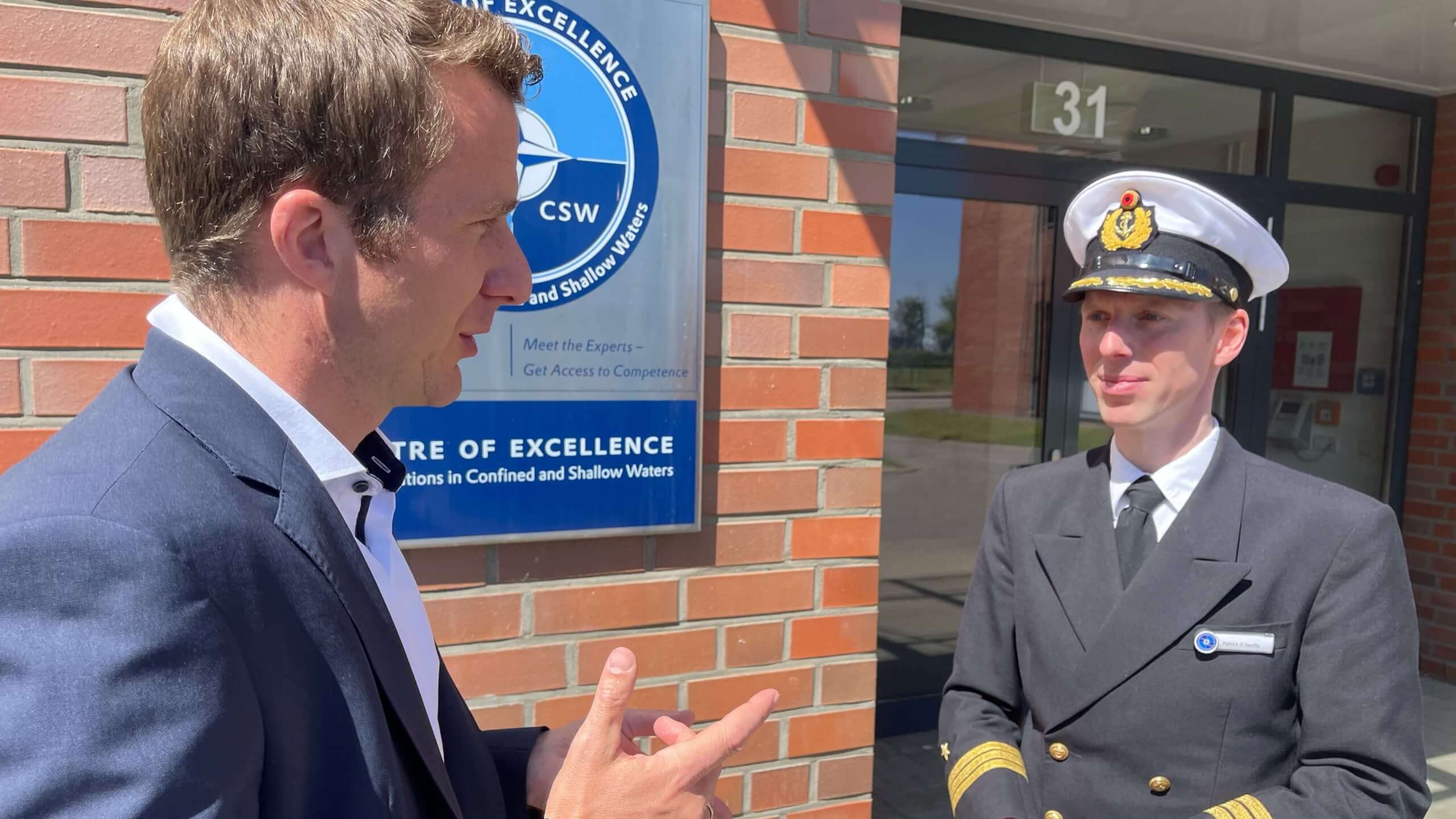
Kiel. The safeguarding of critical underwater infrastructure (CUI) is essential for maintaining global security and economic stability. Recent attacks on the NorthStream pipelines have highlighted the vulnerability of key maritime assets in the Baltic Sea, underscoring the need for enhanced protection of communication cables, pipelines, ports, and offshore wind farms.
In response, Kiel-based cloud geodata specialist north.io and the think tank “Centre of Excellence for Operations in Confined and Shallow Waters” (COE CSW), have embarked on an innovative partnership. With the signing of a Letter of Intent (LOI) in April 2024, both organisations have committed to a joint effort to comprehensively tackle these security challenges.
Integrating commercial and military data
Recognising the imperative of merging maritime operational expertise with technological innovation, this collaboration aims to integrate industrial and military data sources. The goal is to develop a unified situational awareness picture that provides naval and security personnel and analysts with expedited and insightful analyses. for which TrueOcean will function as the underlying Big Data platform.
"Through our collaboration with the COE CSW we have pioneered an innovative project to bridge this existing capability gap," explains Jann Wendt (37), CEO of north.io. "We leverage our well-established 'TrueOcean Data Hub' as a comprehensive Ocean Data Warehouse, serving as the cornerstone for managing ocean big data. This platform standardizes a large variety of maritime datasets and provides standardized information layers for usage in various expert systems. No one except us is going into the technical depth of ocean raw data in the cloud today. The COE CSW on the other hand contributes with its application layer 'Live Situational Picture,' ensuring a secure environment for data access and analysis."
Aim of the cooperation
In a two-month proof of concept, the partners are focusing on developing the initial prototype for an enhanced maritime situational picture. This endeavour aims to improve maritime risk assessments, bolster underwater infrastructure security, and deter adversarial activities. Analysts will examine behavioural patterns, create movement profiles, and react to anomalous under- and above-water activities. The prototype is scheduled for presentation to Chief of the German Navy, Vice Admiral Jan C. Kaack, in June 2024.
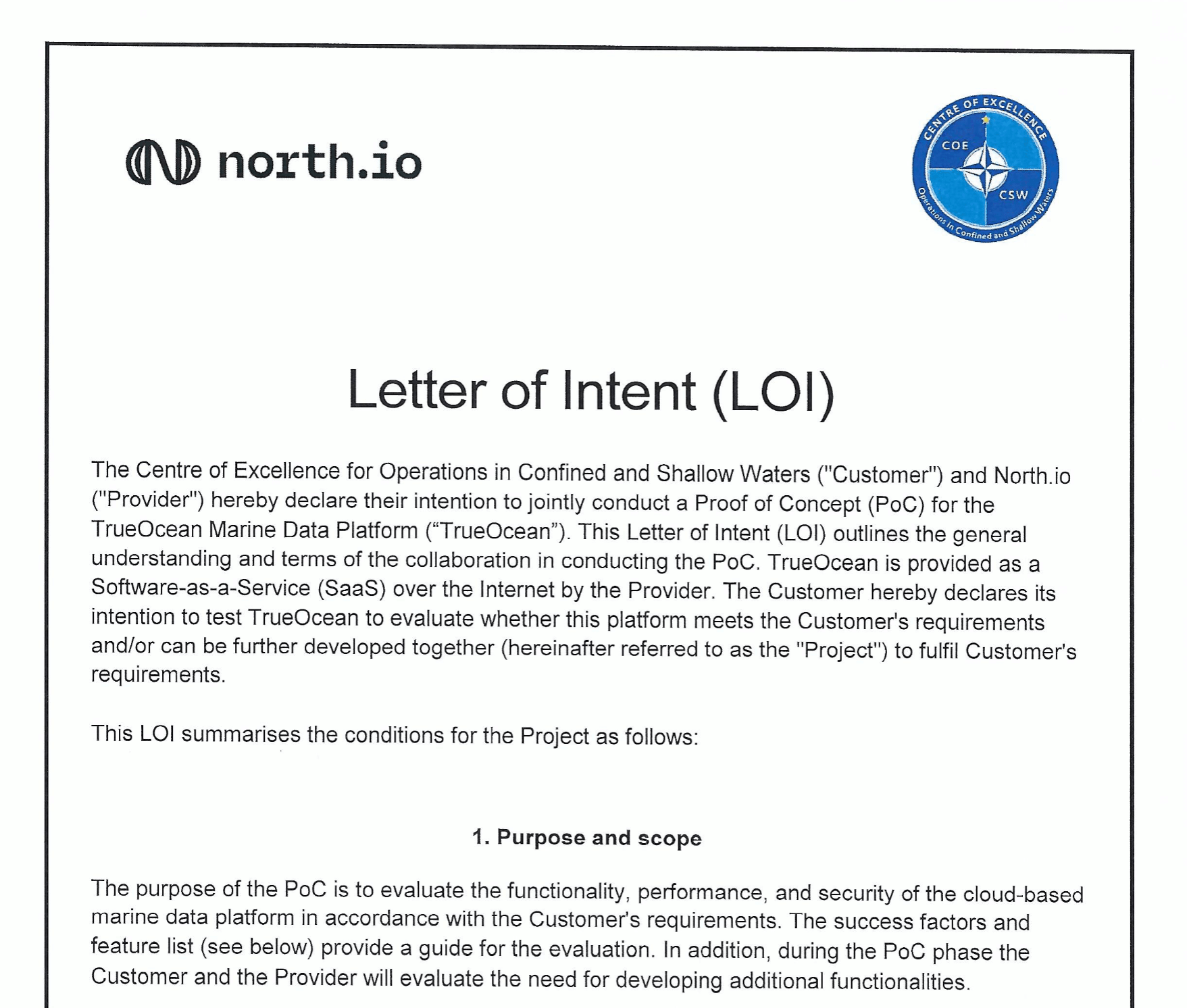
Excerpt of the signed letter of intent between north.io and COE CSW
Successful trials with UICC
Prior to this collaboration, north.io had successfully trialled its software with the Undersea Infrastructure Coordination Cell (UICC) in Brussels, that has been tasked with coordinating NATO nations’ efforts to protect critical underwater infrastructure since February 2023.
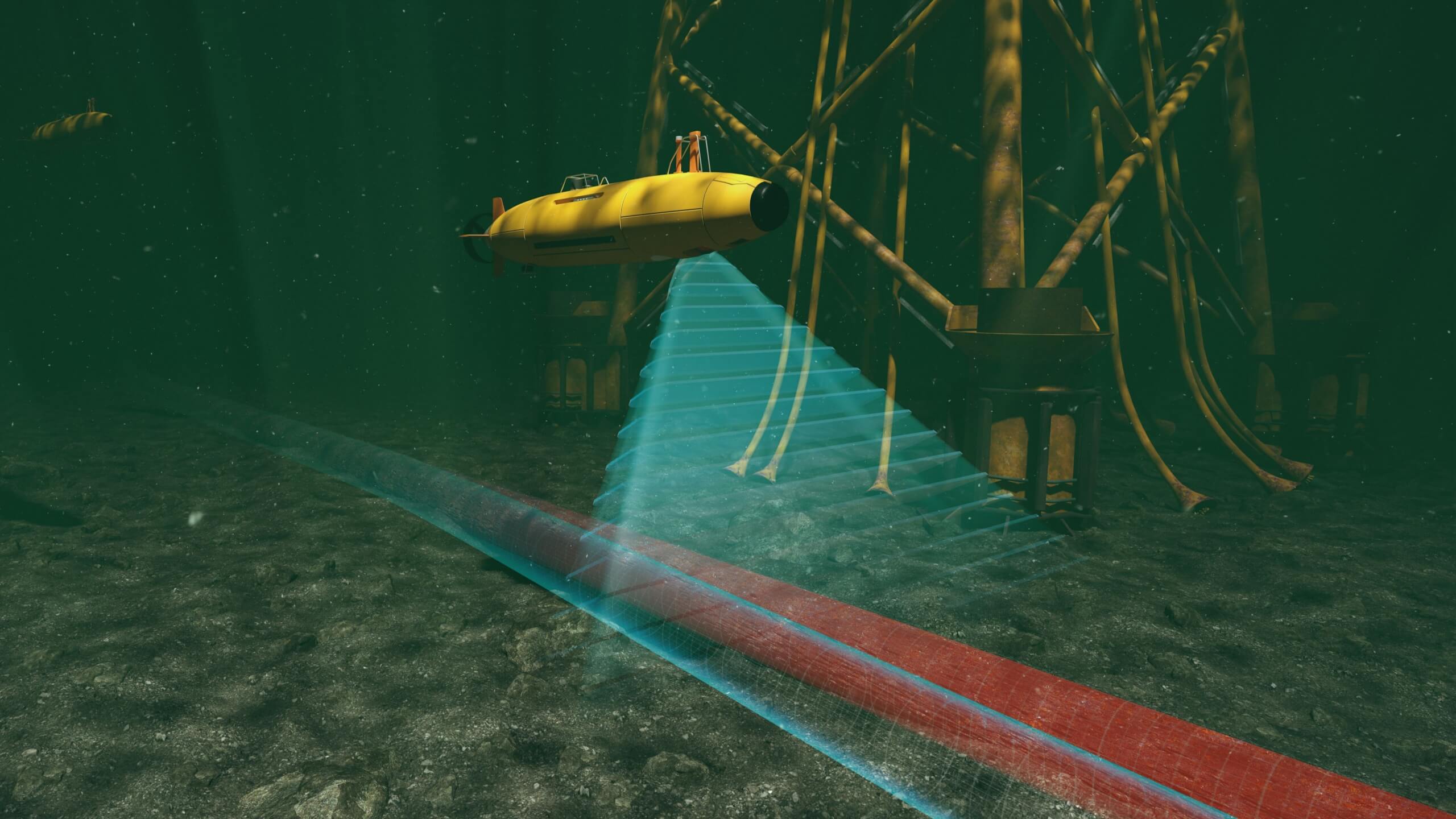
Critical underwater infrastructure protection relies on a multitude of information from a multitude of data sources. north.io brings these data sources together.
Collaboration is essential
Combining the innovative strengths of the geospatial cloud specialists from Kiel with the maritime security expertise of the COE CSW makes sense to Dr Sebastian Bruns, Senior Researcher at the Institute for Security Policy at Kiel University (ISPK): “Just like sea lines of communication, offshore critical infrastructure is distributed across oceans, borders, and jurisdictions. Thus, successfully securing it also depends on a collaborative approach, whether in the Baltic or the North Sea,” explains Bruns. “If we are to secure these vital assets for the prosperity and security of our countries and alliances, it is not only prudent but necessary to access and combine all previously untapped relevant data sources. This is imperative for a better shared situational picture. Combining the benefits of geospatial cloud technology with the integration of artificial intelligence and big data analytics can then further enhance the situational awareness and decision-making processes, providing a solid foundation for CUI protection," Bruns concludes.
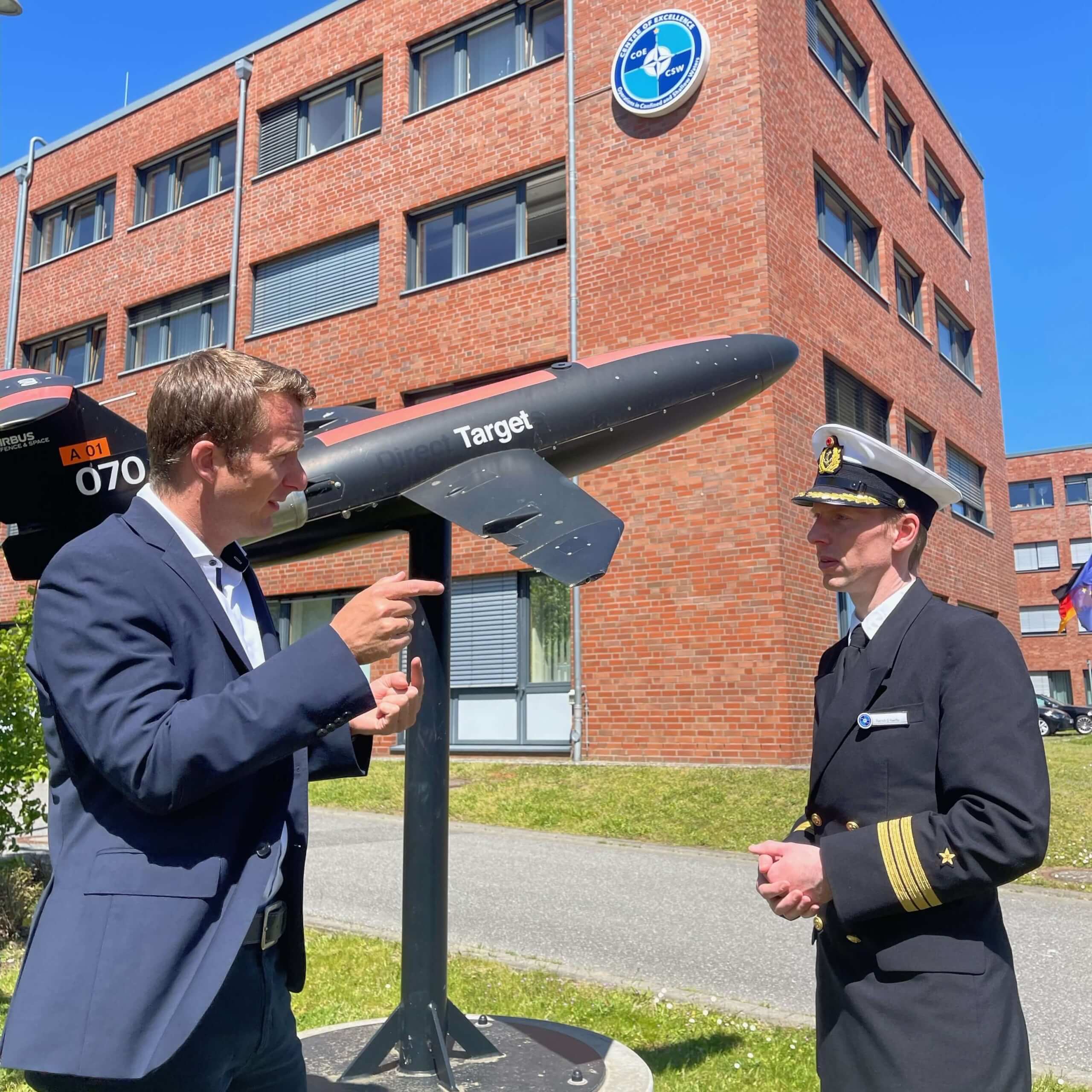
Jann Wendt (north.io) and CDR Patrick O'Keeffe (COE CSW) aim for the same target: making critical underwater infrastructure safer.
High demand for state-of-the-art platform
The increasing need for diverse and expansive data integration has already piqued the interest of several European navies in the Ocean Data platform, envisaging it as the core of a multi-sensor data fusion system. This interest extends beyond naval forces, as north.io has also been commissioned by a national maritime and hydrographic agency to develop a software solution that amalgamates sensor data ranging from the sea to space. This state-of-the-art system will enable government agencies to detect and address maritime anomalies more effectively.
Background Information on CUI Protection
The efficacy of CUI protection relies on two pivotal elements of an appropriate ocean data infrastructure:
- Live Situational Picture: An integrated system that consolidates real-time data from multiple sources, offering a comprehensive perspective on maritime activities. Advanced algorithms are required for data fusion and real-time analytics to efficiently process and present complex data streams.
- Forensics System: A dedicated platform for thorough analysis and examination of historical maritime events, demanding robust computing power, data search and retrieval, storage, and analytical capabilities to handle extensive volumes of surface and subsurface data from various sensors.
The north.io technology is central to this endeavour, acting as a vital standardization and big data layer within the data ecosystem. It serves as a centralized hub that aggregates, standardizes, and secures a vast array of maritime data from disparate sources. This ensures that both the Forensics System and Live Situational Picture have access to diverse data sources via standardized and secure protocols, enabling strategic decision-making based on read-only data transfer.
The effectiveness of ocean data warehouse-approach was showcased during the Tabletop Excercise COREBALT 2023, where TrueOcean successfully streamed datasets directly to the NATO CUI dashboard. The next test of north.io's big data platform is already planned for September 2024 off the coast of Portugal. The multinational REPMUS exercise, which will last several weeks, will test interoperability with unmanned maritime systems in particular.